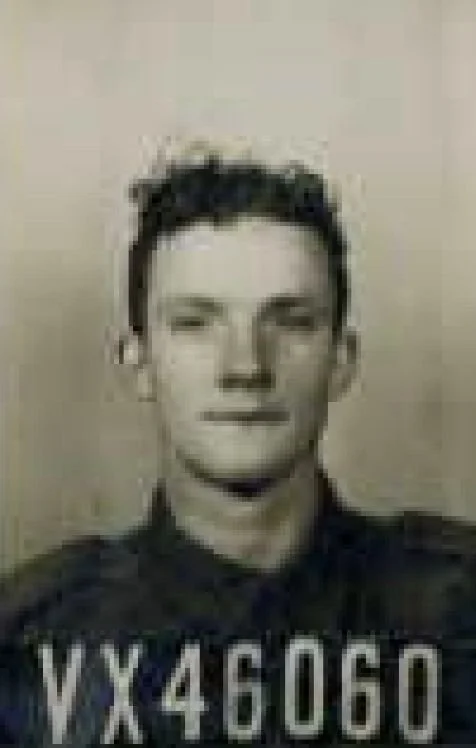
HARRIS Matthew VX46060 D Coy [A Force]
(I have based the following accounts largely on Matt Harris’ autobiography ‘The Unwanted Aussie’, High Country Publishing, 1990; and government war records. Only limited fact-checking has been undertaken. Compiled by Gary Noyes-Brown, August 2026)
EARLY LIFE
Matt Harris was adopted by my mother’s grandparents, Alfred Ernest Harris and his wife Euphemia. He was abandoned at birth by his mother at the door to a children’s institution in Melbourne on the morning of 17 August 1920, at a time of economic difficulty for most in the community. He was nicknamed Matthew Door.
The Harris family, of Nar Nar Goon, provided a loving and caring upbringing during the difficult times of the Great Depression.
Matt enlisted in the 14th Militia Battalion at age 16 while stating he was actually aged 18. After six months he transferred to 52nd Battalion at Dandenong. Militia units undertook three months training at Seymour and there was no love lost between militia forces and the 6th Division of the 2nd AIF based at Puckapunyal.
WWII
Matt signed his attestation form for the Australian Military Forces on 21 June 1940 at Garfield. He was not married and his occupation was listed as ‘driver’. He reported to the Dandenong recruiting centre on 9 July 1940. On 10 July 1940 he left Nar Nar Goon, reporting to the Dandenong Drill Hall and then was taken to the Caulfield Racecourse. His oath of enlistment was signed at Caulfield on the same day.
Next, Matt was off to undertake training at Shepparton Showgrounds, where he suffered from ‘Pucka throat’ which led to pneumonia and then he came down with German measles. He lost six weeks of training which, in the middle of October 1940, resulted in him ultimately missing being deployed to the Middle East / Crete under the command of Thomas Blamey. Instead, Matt was sent to Bonegilla army camp, joining the formation of 2/29 Battalion and was a medical orderly. After three months they were sent to Bathurst for further training then boarded a troop train to Melbourne.
The 2/29 left Melbourne on 29 July 1941 on the Dutch ship ‘SS Marnix van Sint Aldegonde’, bound for Singapore / Malaya. In Singapore, Matt was a Lance Corporal in D Company. He was a first aid stretcher bearer and assisted the medical officer on daily sick inspections.
As the fighting became more dire, Matt was very critical of the Australian politicians and military leaders for underestimating the strength of the Japanese and overestimating allied capabilities. After the fall of Singapore to the Japanese in February 1942, Matt was selected by Capt. Brand to run the 2/29 hospital under Brand’s control at the Changi Barracks. He was later sent to Mergui, Burma in May 1942 aboard the ‘Celebes Maru’, along with three thousand POW’s comprising ‘A’ Force. Here he was commonly known as ‘Doc’ and was part of the medical team headed by Lt. Col. Hamilton, and the surgeon Lt. Col. Albert Coates who convinced Japanese Capt. Ishihara to help him undertake a necessary surgical procedure on Matt. The Japanese were reluctant because they thought Matt was going to die anyway and they didn’t want to waste medical supplies on him. In the end, Coates was able to teach the Japanese how to do the operation which could be utilised for the benefit of their own soldiers.
On 10 August, 1942, the POWs at Mergui were sent north on rice barges to Tavoy where the living quarters housed around 2,500 allied POWs. They learned that the first sod of soil had been turned for a proposed railroad on 2 September, 1942. At the 26 Kilo Kun Knit Kway Camp, the Japanese officer in charge, Colonel Nagatoma, visited and made a half-hour speech to the POWs, of whom the numbers of sick were increasing daily. It was becoming more difficult to produce the manpower numbers required each day by the Japanese. The speech described East-Asian nations having been treated poorly by British and Americans. The speech warned against escape and advised that the POWs were required to work on the railway.
At times when there was very little access to medical supplies, Matt volunteered to go to the Japanese headquarters dispensary to acquire, beg or steal supplies. In early 1943, Coates required Matt to go to the base camp Thanbyuzayat POW’s headquarters to get some much-needed first aid supplies. These supplies would then be dispersed to various camps along the Burma Railway. This was a very high risk and selfless undertaking, carried out successfully. Matt had an extended stay at Thanbyuzayat assisting the Japanese medical staff. When he had the opportunity, Matt would steal bottles of sulphonamide pills (antibacterial drug used to reduce infection rates during WWII, prior to modern antibiotics, which were strictly reserved for the Japanese) from the Japanese stores, which the POWs would benefit from. To fool the Japanese, he would substitute them with similar size and shape zinc oxide pills rubbed into white ipecacuanha powder, which the Japanese would unknowingly use for the themselves.
Thanbyuzayat Camp was so crowded it moved to 30 kilo at Reptu, however this stay was only of short duration. Next there was an order to move to 70 kilo camp. Matt also had spent time at 55 kilo camp.
In April 1944, Matt was transferred to the Tamarkan POW Camp in Thailand near the bridges on the River Kwai (correct name was Mae Klong River at the time, re-named Kwai Yai River in 1970). There was a newly constructed bridge made of steel and concrete; one of 350 along the 425 km railway, completed in one year. It had 11 spans and was located around 200 yards from the camp. In November 1944, allied bombers attacked the bridge and defensive gun emplacements on multiple occasions. One bomb landed in the POW camp, entombing 60 POWs under debris, with six of those dead.
In early 1945, Matt was able to avoid being sent to Japan to undertake labour, due to a hernia. The transport ship he would have been on was subsequently sunk by a US submarine. He then was able to avoid being sent to the Indo-China border due to the presence of an ankle ulcer, as it was determined he would be unfit to work. After hearing rumours of allied advances and enemy retreats he decided to make himself a weapon by fashioning a sharpened bamboo rod (presumably in case he needed to fight), even though this news resulted in the Japanese and Korean guards starting to treat the POWs more humanely. The Korean guards were usually particularly brutal but they were also treated very harshly by the Japanese.
In July 1945, Matt was taken from Tamarkan to the nearby Chungkai Camp. On 9 August 1945 there were rumours of nuclear bombs being dropped on Japan and on 15 August 1945, during a camp concert, the POWs were advised that the war was over. Another week went by, still not trusting of the Japanese and Koreans; when the camp was visited by Lady Edwina Mountbatten (who at the time was Superintendent-in-Chief of the St John Ambulance Brigade).
The long trip home commenced with a train journey to Bangkok, aircraft to Singapore (where they were met by Lord Louis Mountbatten, who was appointed the Supreme Allied Commander – South East Asian Command, by Winston Churchill) and a voyage on the ‘SS Moreton Bay’ back to Fremantle, Western Australia; then on to Port Melbourne in October 1945. He then arrived at Melbourne Showgrounds where he was re-united with his sister Violet, brother Lionel and sister Ina; and finally, back home to Nar Nar Goon. He was discharged from the army on 3 October 1946.
Matt was distressed how leadership treated Gen. Gordon Bennett (Commander of the Australian 8th Division) regarding countering the Japanese jungle methods of fighting. Apparently, Bennett didn’t appreciate the interference by the British in running the 8th Division. Matt believed 8th Division were betrayed and sold-out by the Federal Government and military advisers.